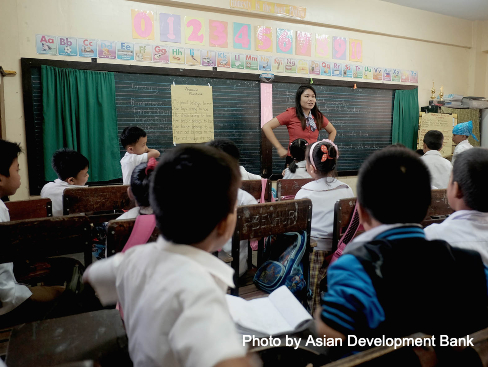
Language mismatch between the classroom and the home can significantly reduce learning outcomes, with Filipino learners paying what researchers describe as a hidden “tax on learning,” according to studies presented during a recent 17cÆð²ÝÊÓƵ (17cÆð²ÝÊÓƵ) webinar.
The webinar brought together findings from two 17cÆð²ÝÊÓƵ-supported studies examining how language affects learning outcomes, literacy development, and the implementation of education policies in the Philippines.
Presenting findings from the study “Linguistic Mismatch and Learning Productivity: Evidence from Mother Tongue-based Education in the Philippines,” 17cÆð²ÝÊÓƵ Senior Research Fellow Michael Ralph Abrigo said learners perform better when the language used in school matches the language they speak and understand at home.
“The mismatch of languages is like taxes,” Abrigo said.
He explained that when students and teachers do not fully understand one another, learners expend additional effort and resources before learning can take place. In the study's theoretical framework, language mismatch functions as a form of deprivation that affects learning productivity.
Using measures of linguistic deprivation, the study estimated that, under a Filipino-English bilingual instructional framework, about 79% of Filipino learners would experience a mismatch between the language used at home and that used in school. The mismatch would be minimal in predominantly Tagalog-speaking areas but much higher in many parts of the Visayas and Mindanao.
According to Abrigo, the policy goal should not simply be to switch languages but to reduce what he described as “school-based linguistic deprivation” by improving language matching in the classroom.
The study found that learners taught in a language they understand perform better not only in their mother tongue but also in Filipino, English, and Mathematics.
“Kapag tinuruan ang bata ng mother tongue, mas magaling sila sa Filipino, mas magaling sila sa English, mas magaling sila sa Math (When children are taught in their mother tongue, they perform better in Filipino, perform better in English, and perform better in Mathematics),” Abrigo said.
Researchers estimated that gains from improved language matching can be equivalent to as much as one year of learning.
“The gains from improving linguistic matching through mother tongue-based multilingual education can be equivalent to as much as one year's worth of learning gain,” he added.
The benefits extend beyond academic performance. The study found that learners were more likely to remain in school when classroom instruction matched the language they understood.
“Mas nagsu-survive ang mga bata sa school, kasi mas natututo sila (Children are more likely to survive in school because they are able to learn more effectively),” Abrigo said, referring to higher student retention rates by 9 to 12 percentage points from Grade 1 to Grade 6, suggesting that mother tongue-based multilingual education (MTB-MLE) influences both learning outcomes and school retention.
Supporting these findings were results from the study “Language of Instruction Transition in Education Systems (LITES)” presented by 17cÆð²ÝÊÓƵ Emeritus Research Fellow Aniceto Orbeta Jr. and consultants Romylyn Metila and Jennifer Monje.
Using data from 1,200 learners across 60 schools, the LITES study found that strong literacy skills were associated with access to first-language learning materials, teacher training in multilingual education, regular school attendance, preschool participation, and the strategic use of learners’ first language in the classroom.
“Children learn best in the language they know and they understand,” Orbeta said.
The study reinforced international evidence showing that a strong foundation in a familiar language supports the acquisition of additional languages.
The LITES study also identified several factors associated with stronger literacy outcomes, including access to first-language learning materials, teacher training in multilingual education, preschool participation, regular attendance, and strategic use of learners' first language in the classroom.
“What the teachers believe matters as much as what the teachers do,” Orbeta said, noting that teacher beliefs, professional development, and access to learning materials all influence literacy outcomes.
At the same time, researchers highlighted continuing implementation challenges. The study found that only about 9% of schools previously met the Department of Education's minimum requirements for effective MTB-MLE implementation.
While significant progress had been made in developing teaching and learning materials in 19 Philippine languages, gaps remained in teacher training, instructional materials, funding, monitoring, and language mapping.
“Language policy works when it is evidence-based, implementable, culturally rooted, and politically understandable,” Metila said.
“For the Philippines, the implication is to improve the conditions under which multilingual education can succeed rather than to abandon it,” she added.
Meanwhile, Monje also noted that successful implementation often depended on whether schools could use the languages spoken by their communities and whether teachers could adapt instruction to learners' needs.
“As always, the challenge is, and has always been, implementation,” Monje said.
Former Department of Education (DepEd) Secretary Edilberto de Jesus said the webinar provided an opportunity to revisit language-in-education issues using current evidence.
“The implementation has to begin with proper linguistic mapping, at the ground level,” he said, noting that migration and demographic changes continue to reshape language use across communities.
Serving as discussant, DepEd Teaching and Learning Division Chief Education Program Specialist Rosalina Villaneza emphasized that language policy discussions should ultimately be evaluated based on their impact on learning.
“What happens to learning when instruction is delivered in a language not fully understood by learners?” she asked. “Learning is not only instruction exposure. It is comprehension and meaning-making.”
Linguist Ricardo Ma. Duran Nolasco likewise highlighted the broader implications of language policy beyond educational outcomes.
“Language policies have implications not only for educational achievement but also for cultural identity, inclusion, and nation-building,” he said.
As the Philippines continues to refine its education policies, experts emphasized that efforts to improve learning outcomes must account for the country's linguistic diversity while ensuring that no learner is left behind due to language barriers.
Watch the webinar playback here: or download the featured studies from and . ### — MJCG