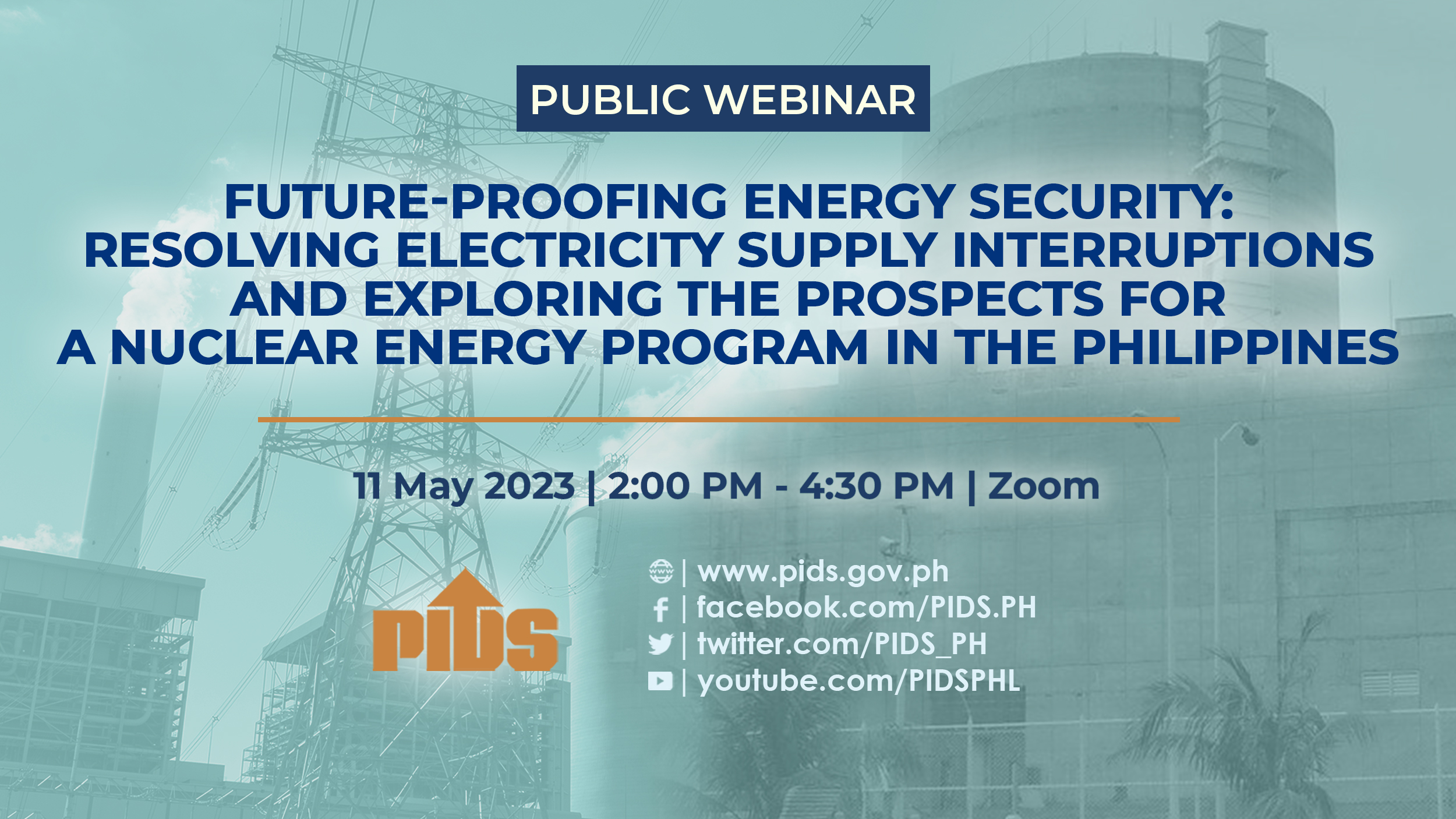
Government electricity subsidies should be better targeted to ensure assistance reaches intended beneficiaries while remaining financially sustainable, according to a study presented at a recent 17c起草视频 (17c起草视频) webinar.
Presenting the study “Making Electricity Subsidies Work: Cross-Country Lessons for Philippine Energy Policy,” 17c起草视频 Senior Research Fellow Dr. Kris Francisco said the country’s major electricity subsidy programs—the Universal Charge for Missionary Electrification (UCME), Lifeline Rate, and Senior Citizen Discount—face mounting fiscal and implementation challenges despite their important role in promoting access to energy.
“We treat electricity as a basic need,” Francisco said, noting that subsidy programs help households participate more productively in the economy and support broader development goals.
The study found that under earlier consumption-based eligibility arrangements, more than 60 percent of households in many regions qualified for lifeline rate benefits, raising concerns that subsidies were not reaching those who needed them most.
Francisco explained that relying solely on electricity consumption as a proxy for poverty may not always accurately identify households that need assistance.
“Lower consumption does not necessarily mean that a household is poorer,” she said. “Consumption thresholds alone are not enough to identify poor households and should be complemented with household welfare data.”
She explained that some low-income households may appear to consume more electricity because they share meters with other families, while some higher-income households may keep consumption low through solar panels or energy-efficient appliances.
The study also pointed to rising subsidy costs. Expenditures for the Universal Charge for Missionary Electrification (UCME), which supports electricity access in off-grid and remote areas, increased from P7.05 billion in 2020 to a projected P28.6 billion in 2024.
Despite these challenges, Francisco stressed that the study does not advocate removing electricity subsidies.
“We are not recommending the removal of these cross-subsidies because we believe they are serving an important equity goal,” Francisco stressed. “Our priority is simply to improve targeting and reduce leakages.”
To improve program delivery, the study recommends strengthening the integration of existing welfare and administrative databases—including the Philippine Statistics Authority’s Family Income and Expenditure Survey (FIES), the Department of Social Welfare and Development’s 4Ps and Listahanan databases, and utility consumer records.
Reacting to the findings, Department of Energy (DOE) Power Market Development Division Officer-in-Charge Antonio Barcelona said recent reforms have already addressed some of the weaknesses identified in earlier lifeline rate arrangements.
Barcelona cited Republic Act No. 11552, which linked eligibility for the lifeline rate program to 4Ps beneficiaries and indigent households certified by local government units, reducing reliance on the electricity consumption threshold alone.
In the case of UCME, he explained that the subsidy remains necessary to support consumers in missionary or off-grid areas, where electricity generation costs remain substantially higher due to reliance on diesel-based power generation.
To reduce long-term subsidy dependence, he highlighted DOE graduation policies and ongoing hybridization projects that integrate renewable energy technologies into off-grid systems.
For Barcelona, these reforms help ensure that assistance remains focused on households and communities that continue to face high electricity costs and limited access to reliable power.
Both Francisco and Barcelona agreed that electricity subsidies remain necessary. The challenge, they said, is ensuring that assistance reaches those who genuinely need support while keeping programs efficient, equitable, and sustainable.
Watch the webinar playback here: or download the featured study from . ### — MJCG