Recent rotational brownouts in Luzon have renewed calls to modernize the country's power grid after the tripping of major transmission lines triggered supply shortages across parts of the island.
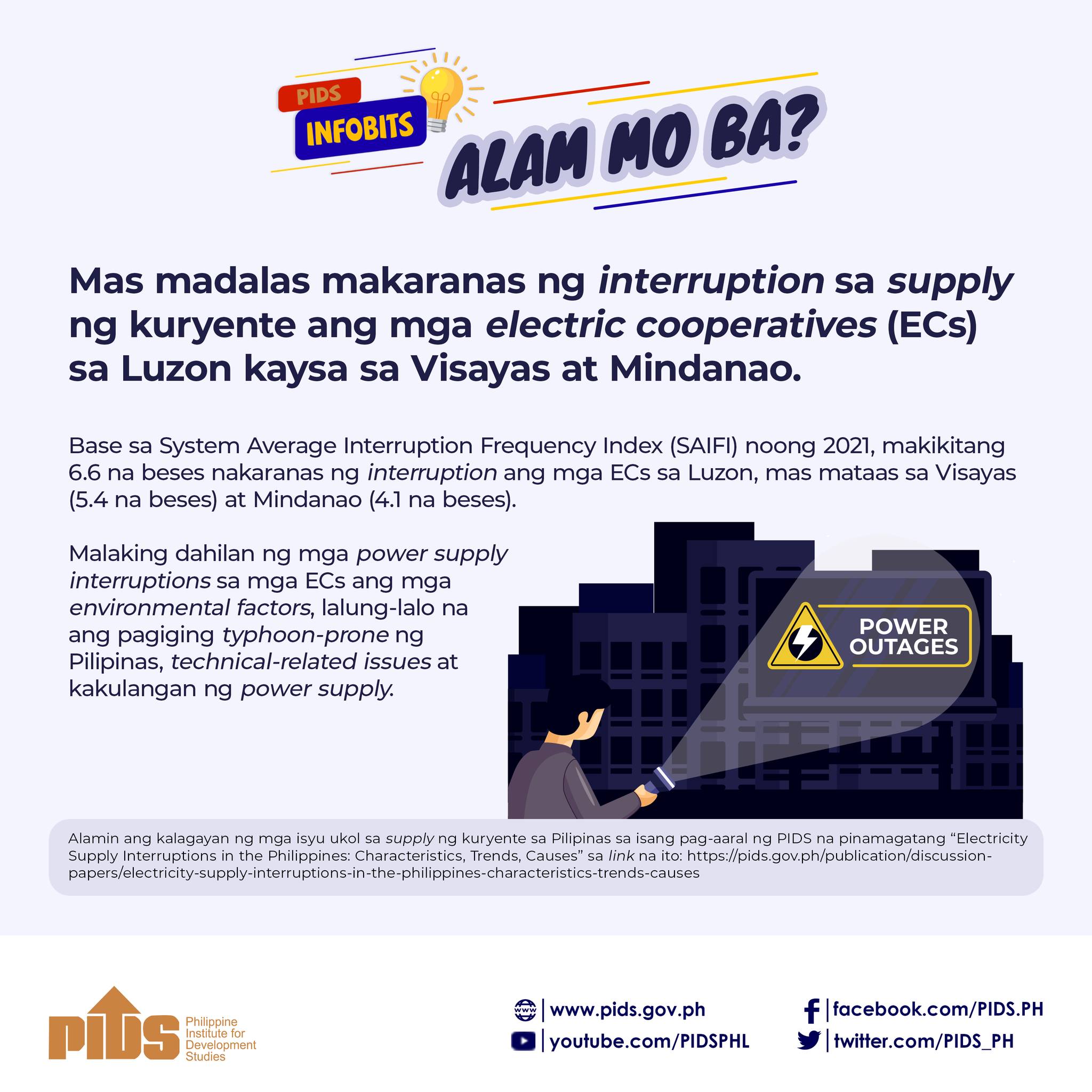
Speaking at a webinar organized by the 17cÆð²ÝÊÓƵ (17cÆð²ÝÊÓƵ), Senior Research Fellow Dr. Adoracion Navarro said the incident exposed vulnerabilities in the power sector, including limited reserve margins, dependence on a few large generating plants, and transmission bottlenecks.
"The rolling brownouts underscored the Philippines' power vulnerability. It is no longer just a matter of insufficient generation capacity. Increasingly, it is a grid resilience problem," Navarro said.
According to Navarro, delays in transmission expansion and grid modernization are making it harder for the power system to keep pace with growing electricity demand and the transition to renewable energy.
As of January 2025, only 75 of 258 planned transmission projects had reportedly been completed, according to her presentation, raising concerns about the pace of grid development amid rising electricity demand.
Navarro also pointed to delays in regulatory reviews, right-of-way acquisition, and permitting processes as major obstacles to transmission expansion. These constraints are becoming increasingly important as the country seeks to expand renewable energy capacity.
“Insufficient transmission capacity is causing congestion, delaying grid expansion, and limiting integration of new and renewable energy,” she said.
Former Energy Regulatory Commission (ERC) chairperson Atty. Monalisa Dimalanta, who served as discussant during the webinar, said many of today’s transmission challenges can be traced to the historical foundations of the country’s power system.
“We need to understand and appreciate—so that we can formulate the correct solutions—that our grid is a heritage grid,” she explained.
According to Dimalanta, the country's transmission network was built for a power industry once controlled by a single entity, from generation to delivery.
“It is built on a backbone that was designed as a highly centralized and vertically integrated system, meaning iisa lang ang may-ari mula sa paggawa hanggang sa pagde-deliver ng kuryente,” she said.
Dimalanta noted that while the Electric Power Industry Reform Act (EPIRA) of 2001 introduced competition and restructured the sector, much of the transmission backbone was designed long before these changes.
Today, the power sector involves multiple market participants and growing shares of renewable energy, placing new demands on a grid that was built for a very different operating environment.
To address these challenges and help prevent similar interruptions, Navarro called for stronger implementation of the country’s Transmission Development Plan, faster right-of-way acquisition, improved interagency coordination, and greater accountability for project delays.
She also urged reforms to strengthen the ERC's technical capacity, enforcement powers, and institutional independence.
“If there are weaknesses in regulatory action, this amplifies uncertainty, distorts incentives, and fuels perceptions of regulatory capture,” she said.
Both Navarro and Dimalanta stressed that strengthening the transmission network will be crucial not only for improving reliability but also for supporting renewable energy development and meeting the country's growing electricity needs.
Download a copy of Dr. Navarro’s study at .
Watch the webinar: . ###